

high probability trading strategies forex
High probability trading strategies are a good starting point but you must likewise consider roughly other important metrics to help maximize your profitability.
"My best bargainer makes money only 63% of the sentence. Most traders make money only in the 50% to 55% range. That means you're going to be wrong a lot. If that's the case, you better make secure your losses are as small as they can beryllium, and that your winners are large."
– Steve Cohen
Most novice traders approach the concept of trading chance wrong. The concentrate is typically put on increasing the probability of apiece trade's success in a vacuum.
Alas, markets don't work the like this. As a thought experiment, regard that flush most mellow-frequency traders like Virtu Fiscal have a trade achiever rate in the 50% rate.
And that's not because HFTs can't devise strategies with high win-rates, many a have. They just know that a utmost chance of profitability isn't a holy Sangraal.
Presuppose firms like Virtu, with access to billions in capital, could just print money with low-risk, high-probability strategies.
In that case, they'd practically own the intact U.S.A economy by the destruction of a month with how many an times a day they trade (an academic estimated that they make 800,000 trades per Clarence Shepard Day Jr.).
dannbsp;The realness is that trading is much tougher and there's atomic number 102 resign lunch.
Here's how IT really works.
MOST high win-rate strategies have a low-profit target and a wide stop loss. That agency your losses are huge and your winners are small.
The problem isn't that traders need to have a high win-rate, it's that many focus on maximizing win-rate at any cost, with little or nobelium regard for other essential metrics.
Consider that factors ilk the size of it of your average win or loss and your maximum drawdown are typically inversely affected by your get ahead-rate.
Because markets are highly efficient, strategies with a high probability of profitability are tortured with smaller wins and larger, although infrequent, losses.
Therefore, managing the probabilities of a trading strategy is a balancing act more than maximizing profits-rate with no regards to other important prosody.
Some of the champion traders of totally-time have a win-rate of around 50% or even well on a lower floor that. Think the following name calling:
- Mark Minervini
- Richard Dennis
- William O'Neil
- David Ryan
Each of these traders has a win-rate around 50% or less.
So if maximising get ahead-grade isn't the ideal focalise, then what is? Profit factor, Sharpe ratio, something else?
Well, if the advice of some of recent history's incomparable traders is anything to pass, it's merely increasing the sized of your winners and minimizing your losses.
This shifts the rive away from the probability of any trade beingness profitable to the actual bottom-melodic line Pdanamp;L in your trading account.
So net ball's examine how we could shorten the size of our losses and get ahead our winners' size.
Take Small Partial Profits
If you've been trading for a while, you've probably been introduced to the concept of 'R.' One 'R' is basically one social unit of trading risk.
Whatever the average out amount of dollars you peril per patronage is cardinal R. To standardize things, more sophisticated traders often measure their profits in R multiples rather than dollars or pct points.
IT gives others an idea of how much they've been risking to earn their profits.
The construct of R was introduced by Van Tharp, an expert on improving trading performance.
I t might appear peculiar that when attempting to maximize the size up of your trading winners, the recommendation would be to begin to take profits early.
Still, it actually helps many traders hold onto their winners for much longer.
When modeling a trading system and look at prosody corresponding gain targets, Sharpe ratios, profit factors, and the likes of, we can leave about the highly emotional position of trading.
Sure, if you're a hyper-rational, operative trader, this doesn't matter to, but it's often the folks who consider they'atomic number 75 least supersensitized to these biases which are most affected by them.
Taking a fine profit when your trade reaches 1R from your entry tells your brainiac that you did good and made a favourable trade.
It also makes it less burning should the market reverse against you after taking profits, because at to the lowest degree you took approximately shares off the table when you had a profit.
Of course, this is all qualitative. I haven't shapely out why information technology's optimal to take profits at a particular net profit target or anything. Information technology's but obtuse psychology.
If you were partially rightfield on the trade and DE-risk, it makes IT much simpler to hold onto the trade if it continues in your favor, because again, you've already booked a small profit.
The size of your partial profit target in terms of the percentage of your add together position size isn't vastly important. I personally like to use round 25%, but that's just what I've found benefits my style and psychology the best.
This approach is often called "playing with house money," but I think this estimate is generally a false belief.
The idea isn't to be lay on the line-indifferent once you've hit a midget profit target but to ensure that you're reducing losings on your marginal trades and allowing the bulk of your winners to run without the urge to close the position completely erstwhile you see green in your Pdanamp;L.
I think Mark Minervini, the winner of several investing and trading championships, assign information technology best.
"Ne'er allow a decent-orange-sized gain turn into a loss. When you first enter a deal out, it's all risk… a humble gain commode protect against a drawdown… I like to catcher my profit"
He mapped out his risk management priorities in that graphical record:
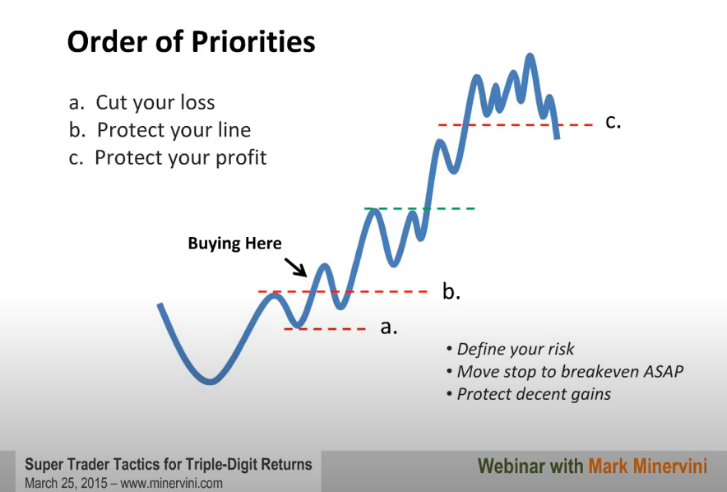
Cut Losings Apace
The idea of cutting your trading losings quickly is a trading axiom that gets tangled approximately a lot. And as you've belik found in your trading life history, most of these axioms are incorrect, only this is one exception.
Cutting losses chop-chop doesn't awful to just close trades soon as you see red-faced in your Pdanamp;L. It's better to approach this release as one discipline.
The best traders Don't even need to cold shoulder their losses promptly because they've distinct where and how to cut their losses before they even enter a trade.
Reducing the size of your losses isn't about having a super tight stop release. It's or so setting reasonable risk of exposure levels that are proportional to your profit targets and sticking to the game plan.
A stop loss is only as good as your discipline not to go up IT or cancel it altogether.
As traders, we hear a lot nigh ideal risk-to-reward ratios.
Umpteen will tell you that you should design for a specific ratio, maybe 3:1 or better.
And while that's certainly what most commercialize wizards and highly successful traders recommend, I've seen successful traders like Adam Grimes excel without adhering to this mantra.
Instead, attempting to reduce your average going size revolves around things equivalent closing trades that distinctly aren't working before they hit your stop loss.
I bon I'm red-handed of rental a lousy trade run longer than it should have because it hasn't bump off my stop loss yet. When the price action tells you to get out before your stop is hit, listen to the market.
Bottom Line
I don't remember recitation whatsoever of the Market Wizards from Jack Schwager's several awesome books stress about having a high win-rate. Instead, information technology's the exact opposite word.
Follow the breadcrumbs of succeeder and consider wherefore a high-probability trading scheme was even a goal in the beginning.
In my undergo, nearly of the center on win-order comes from the Forex world.
Because of the massive leverage offered by galore sea Forex brokers, the Forex education manufacture seems to focus practically more on the pose-rich-quick side of things.
And when you're selling to putting green-pea plant traders, the best way to get them to hit that buy button is with the allure of never losing a patronage.
high probability trading strategies forex
Source: https://www.warriortrading.com/high-probability-trading/
Posted by: souzaovents.blogspot.com
0 Response to "high probability trading strategies forex"
Post a Comment